Where AI pays off first: an impact-vs-effort map for consumer-tech teams
Every consumer-tech team we meet has the same backlog: forty AI ideas, four people, and one quarter. The teams that win don't have better ideas, they sequence them better. The single most useful artifact for that is a map: impact versus effort.
Here's the version we use to decide what to do first.
Related reading: how to prioritize AI use cases, AI use cases for subscription businesses, and the Durable AI Index.
The four zones
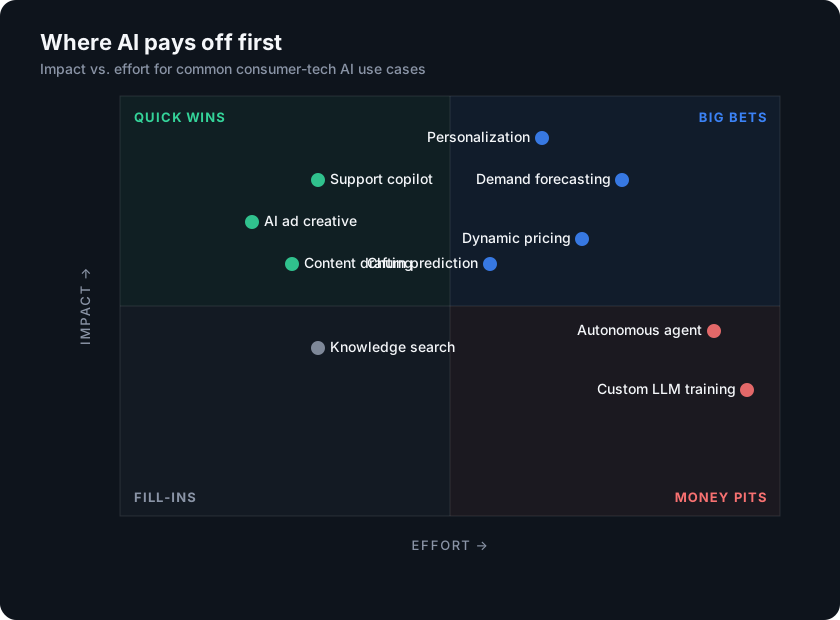
Two axes, four very different decisions:
- Quick wins (high impact, low effort), support copilots, AI ad creative, content drafting. Do these now. They fund credibility and budget for everything else.
- Big bets (high impact, high effort), personalization, demand forecasting, dynamic pricing. Real moat, real work. Pick one, resource it properly, name an owner.
- Fill-ins (low impact, low effort), internal knowledge search and the like. Fine to ship, never your headline.
- Money pits (low impact, high effort), fully autonomous agents and custom model training, before you've earned the basics. Seductive in a demo, brutal on the P&L.
The teams that win don't have better ideas. They sequence them better.
Score before you plot
"Impact" and "effort" should be numbers, not vibes. We score each candidate 1-10 on both, with a quick rubric, so the map is defensible in a room full of opinions.
| Use case | Impact (1-10) | Effort (1-10) | Zone |
|---|---|---|---|
| Support copilot | 8 | 3 | Quick win |
| AI ad creative | 7 | 2 | Quick win |
| Personalization engine | 9 | 6 | Big bet |
| Demand forecasting | 8 | 8 | Big bet |
| Knowledge search | 4 | 3 | Fill-in |
| Fully autonomous agent | 4 | 9 | Money pit |
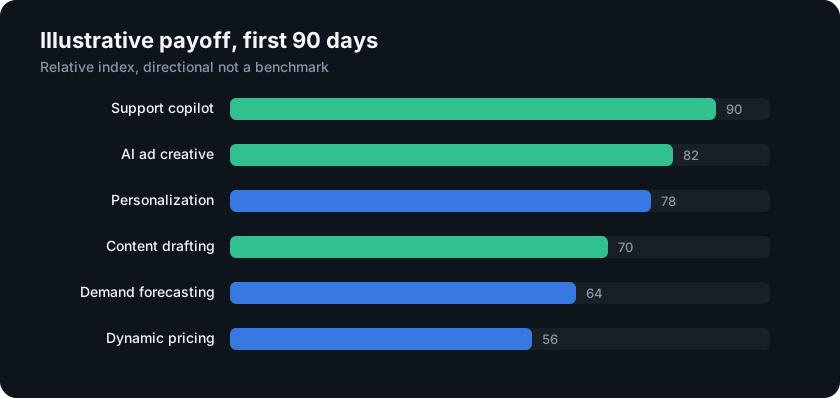
Roughly how the payoff stacks up in the first 90 days (directional, not a benchmark):
How to run the exercise
- List every candidate, no filtering yet. Aim for 20-40.
- Score impact and effort 1-10 with a shared rubric (impact = P&L line moved; effort = data, integration, change management).
- Plot and cluster. The map usually makes the argument for you.
- Commit: all quick wins now, exactly one big bet, fill-ins as capacity allows, money pits parked until you've earned them.
- Re-map every quarter. Effort scores drop as your team builds the muscle, yesterday's big bet becomes tomorrow's quick win.
The takeaway
- Sequence beats selection. The order you do things in matters more than the list.
- Quick wins are strategic, not consolation prizes, they fund the big bets.
- One big bet at a time. Spreading effort across several is how both stall.
- The map moves. Re-score quarterly as effort falls.
Want this run against your actual backlog? That's the first thing we do. See how we work, read the companion case study on AI marketing trends, or book a free AI teardown and we'll map your top opportunities live.

Author
Written by Ankur Garg. Ex-Great Learning and Capital One, with an IIM-Ahmedabad MBA and an IIT-Madras engineering degree. Has built AI products, sold them into enterprises, scaled EdTech from zero, and led P&L, regulatory and BFSI transformation. Advises mid-market and consumer-tech teams on AI strategy, process redesign, and the adoption work that makes AI actually pay off.
Ankur Garg on LinkedIn ↗Want this for your team?
Book a free 30-minute AI opportunity assessment. You'll leave with at least one concrete idea.
Book a call →Discussion
Comments are coming soon.