Tokenmaxxing is out. Valuemaxxing is the metric that matters.
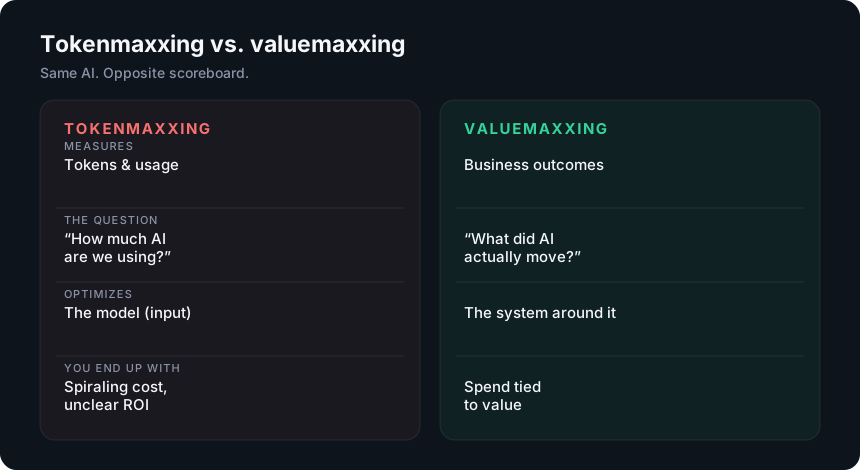
For two years the unspoken AI strategy at most companies was simple: use more of it. More copilots, more calls, more tokens, on the faith that consumption would convert into results. IBM gave the behaviour a name this year: tokenmaxxing. And the bill finally came due.
The reckoning is here because the math stopped hiding. Token spend climbed; the ROI didn't. As IBM put it in Tokenmaxxing is dead, long live valuemaxxing, token consumption is a cost signal, not a value metric. We'd go further: it's the same mistake we see in every stalled AI initiative, measuring the activity instead of the outcome.
Related reading: a framework for measuring AI ROI, why most AI spend creates no value, and why almost no one makes AI pay off.
Why minimizing tokens is the same trap
The instinctive correction, slash usage, cap spend, misses the point in the exact same way. Token minimizing and token maximizing both treat tokens as the number that matters. Neither asks the only question that does: did this move the business? You can cut your AI bill in half and destroy more value than you saved.
Token consumption is a cost signal, not a value metric. Optimizing either direction still optimizes the wrong thing.
Valuemaxxing: outcomes over inputs
Valuemaxxing reframes the scoreboard around outcomes. And it comes with a strategic consequence worth sitting with: the advantage has moved off the model. When everyone can call the same frontier models, the model is no longer the differentiator. The system around it is, context management, workflow orchestration, memory, governance, and evaluation.
If outcomes matter more than tokens, then systems (your outputs) matter more than models (your inputs). That single inversion changes where you spend your time, your budget, and your best people.
What valuemaxxing looks like in practice
- Tie every use case to a P&L line. Not "hours saved" or "messages sent", a number an owner is accountable for. If you can't name it, you're tokenmaxxing.
- Route the model to the task. Default-to-the-most-powerful-model is how token bills explode. Use frontier models where they earn it and smaller, cheaper, or open models everywhere else. IBM's own internal tooling leans on intelligent model routing for exactly this reason.
- Invest in the system, not the call. Retrieval, memory, evaluation harnesses, and guardrails are where durable advantage compounds, and where most teams under-invest because it doesn't demo.
- Measure value per dollar, not tokens per task. Cost is fine when it tracks value. Track the ratio, review it monthly, and let it guide where you scale up or cut.
Why this is the whole game for mid-market teams
This is, frankly, the thesis we built 10dem on. The model is the easy part; the value is in the operating system around it, process, people, and the discipline to measure outcomes. Tokenmaxxing was always going to end this way, because anyone can spin up AI, almost no one makes it pay off.
For mid-market consumer-tech teams the stakes are sharper: you don't have hyperscaler budgets to waste on consumption you can't tie to revenue. Valuemaxxing isn't a nicer philosophy, it's the only affordable one.
The takeaway
- Tokens are a cost, not a result. Maximizing or minimizing them both miss the point.
- The edge moved off the model to the system around it.
- Anchor on a P&L number, route models to tasks, and invest in the plumbing.
- Measure value per dollar, and let that, not usage, set the roadmap.
Concept and framing credit to IBM's Think Insights. If you want help moving your own AI program from tokenmaxxing to valuemaxxing, see how we work or book a free AI teardown.

Author
Written by Ankur Garg. Ex-Great Learning and Capital One, with an IIM-Ahmedabad MBA and an IIT-Madras engineering degree. Has built AI products, sold them into enterprises, scaled EdTech from zero, and led P&L, regulatory and BFSI transformation. Advises mid-market and consumer-tech teams on AI strategy, process redesign, and the adoption work that makes AI actually pay off.
Ankur Garg on LinkedIn ↗Want this for your team?
Book a free 30-minute AI opportunity assessment. You'll leave with at least one concrete idea.
Book a call →Discussion
Comments are coming soon.